

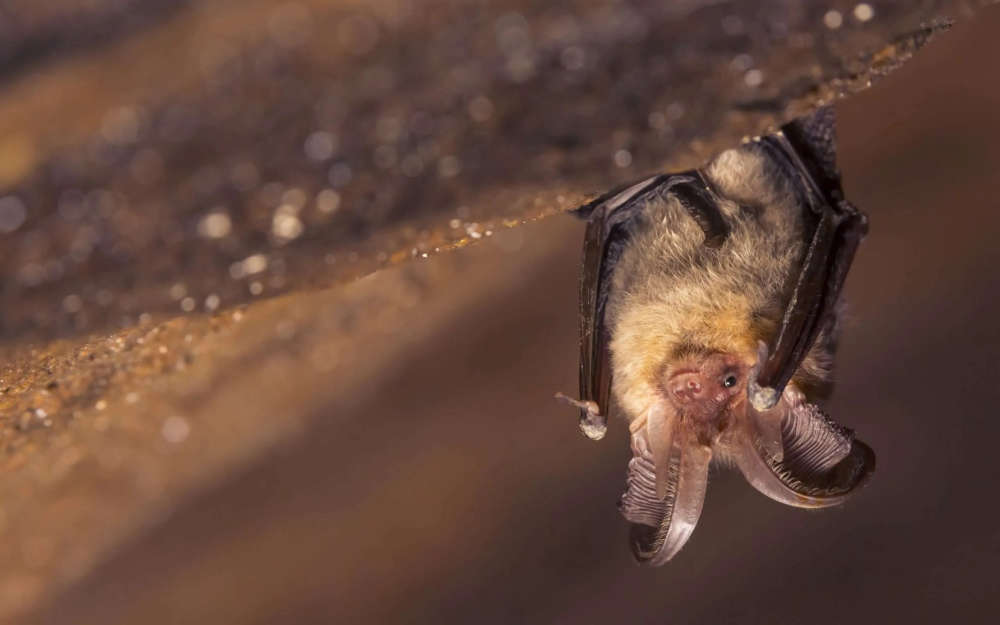
Biologists are asking the public to help monitor local bat populations by reporting dead bats and unusual daytime bat activity during the winter months.
The North Island Community Bat Program is looking for reports that could help detect white-nose syndrome, a fatal fungal disease that has killed millions of bats across North America.
The disease has been confirmed in parts of the U.S. and Alberta, and the fungus has already been detected in a bat guano sample in southern British Columbia, though no bats in B.C. have yet shown visible signs of the illness.
White-nose syndrome spreads mainly through bat-to-bat contact during hibernation in cool, humid environments.
Infected bats can develop white fungus on their muzzle, ears, and wings, causing them to wake frequently during hibernation.
That leads to dehydration and extreme energy loss, sometimes forcing bats to fly during daylight in winter, when food is scarce.
Many eventually starve and die.
The bat program says all B.C. bats eat insects and play a key role in controlling pests, including mosquitoes.
Seven of the province’s 15 bat species could be severely affected, including the Little Brown Myotis and Northern Myotis, both already listed as endangered in Canada.
Residents are urged to report any daytime bat activity in winter, as well as sick or dead bats, up until May 31.
People are reminded never to touch bats with bare hands. Live bats should be left alone, photographed from a distance, and reported.
Dead bats can be collected, but only after contacting the North Island Community Bat Program for instructions.
Reports can be made online at BC Bats, by calling 1-855-9BC-BATS extension 25, or by emailing northisland@bcbats.ca.
To learn more, visit Government of British Columbia.
 Town Of Comox Moves Ahead With Fire Hall Replacement Project
 City Of Courtenay Budget Simulator Closes Today
 Campbell River Sees Seven Black Bears Killed In 2025
 Gofundme Established For Family Of Piper James
 Isfeld Secondary Grad 2026 Dessert Night